How to Break the Binge–Restrict Cycle
What often prompts people to begin working on their relationship with food is distress they feel with binge eating. Bingeing can feel chaotic, frustrating, or confusing, and it’s common to assume the bingeing itself is the problem that needs to be “fixed”.
What many people don’t realize is that bingeing and restriction are part of a cycle that feeds itself. The bingeing tends to get all the attention because it feels intense or out of control and often comes with a fear of gaining weight. Yet the restriction—whether or intentional or accidental -- is a main driver of the cycle. Understanding this pattern can be a powerful step toward a calmer, more trusting relationship with food.
What Is the Binge–Restrict Cycle?
The binge–restrict cycle is a pattern where periods of bingeing (eating what feels like large amounts of food and feeling out of control) are followed by attempts to compensate, regain control, or “be better” with food.
The pattern often looks something like this:
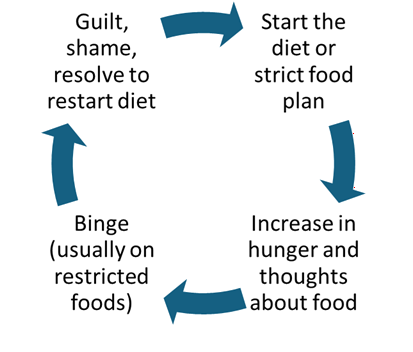
Due to the physical and psychological discomfort that comes with bingeing, most people focus their efforts on stopping the bingeing. But as you can see in the diagram, when the underlying restriction remains in place, the cycle keeps restarting.
Why Restriction Fuels the Cycle
When we think of restriction, we are often thinking of examples rigid diets like cutting carbs or counting calories. These are classic examples that show up in particular when folks are trying to lose weight and can absolutely result in getting stuck in this binge restrict cycle. But restriction can also show up in quieter ways, such as:
Skipping meals because you’re busy
Waiting too long between meals to eat
Avoiding certain foods you enjoy because you’re trying to “be good” with food
Telling yourself you should have less than what your body is asking for
When the body experiences restriction—whether physical or psychological—it responds in ways that are meant to protect you: hunger signals get stronger, thoughts about food may become more frequent, and cravings for restricted foods become more urgent or compelling.
When food finally becomes available, the body responds by compensating for the deprivation and restoring the balance. From the body’s perspective, this response makes sense. It’s an attempt to recover from a period of scarcity.
Why Focusing Only on Bingeing Doesn’t Work
When bingeing happens, it’s natural to want to prevent it from happening again. Many people respond by tightening their rules around food or trying to regain control. But this just creates more restriction (and reinforces the shame and guilt), which sets the stage for the next binge.
In other words: The binge feels like the problem, but the restriction is what keeps the cycle going.
Signs You May Be Stuck in the Cycle
Some common experiences include:
Feeling “on track” with eating early in your day, but “losing control” later
Feeling like you can’t keep certain foods in the house for fear of bingeing
Promising yourself you’ll “start over” with your diet tomorrow
Feeling preoccupied by food when you’d rather be focusing on other things
These experiences are often interpreted as personal failure. But they are frequently the predictable result of restriction and unmet needs.
How to Start Breaking the Cycle
Healing the binge–restrict cycle begins by addressing the restriction that fuels it. Here are some gentle places to begin.
1. Eat regularly throughout the day
Try to eat consistently throughout the day, having either a meal or a snack every 3-4 hours. Going 5+ hours without food will likely set you up for intense hunger and more likely trigger a binge type of experience with whatever food happens to be easiest and fastest. Start with a small step, like having a planned snack between lunch and dinner, or if you’re a breakfast skipper, starting your day with a yogurt and fruit.
2. Allow all foods to have a place
When certain foods are labeled as forbidden or off limits, they often become more powerful and preoccupying, fueling the psychological drive toward binge eating. Allowing yourself to include foods you enjoy can reduce the sense of urgency or scarcity that drives the cycle. I dive more into this idea in another post.
3. Be curious about your own hunger and fullness cues
Hunger can show up in many different ways; it’s not just stomach growling. Hunger can impact focus, mood, and energy levels in subtle or obvious ways. Reconnecting with internal cues can take time, especially if eating patterns have been shaped by rules or restriction. Instead of trying to “perfectly” follow hunger or fullness signals, simply becoming curious about them can help rebuild trust with your body.
4. Practice self-compassion
Bingeing often carries a lot of shame, and you can see in the diagram above that shame and guilt feed the cycle. Remember that a binge can be your body’s natural and predictable response to unmet needs. Shifting from judgment to understanding can make it easier to move toward change.
Healing Your Relationship With Food Takes Time
Breaking the binge–restrict cycle isn’t about finding the perfect strategy or having more willpower. It’s about creating enough safety, nourishment, and flexibility with food that the cycle no longer has momentum and eventually dissolves away.